Can you imagine living with the time-honored tradition (bolstered by an official decree of government) of not being able to leave your job without giving two years notice? Or not being able to travel as far as a mile away from your home and job without receiving official permission? Can you imagine being so valued that you are not allowed to dig in a garden for fear you might hurt your hands? Can you imagine a time when although the same raw materials and tools are available to all, the special craft surrounding crystal and glass manufacture is passed only through family tradition from one person down to the next?
Such is the case among glassworkers in factories in France and elsewhere in the 17th century. Continuity was such that even today, the family names around Moselle Lorraine in France where glassmaking is believed to have been ongoing since the 15th century are still found. Glassmaking was a competitive business filled with experimentation and exploration in the manner of pouring, flattening, and refiring and using carefully concocted combinations of potash, sand, iron oxide, fern-ash, limestone, and manganese to produce clarity in glass; particularly window glass.
For those who have visited the glass flowers at Harvard University (Cambridge, Massachusetts) in the Ware Collection of Glass Models of Plants, you may recall that the story of sharing glass processes developed over generations repeats with the Blaschka family. Father Leopold and son Rudolf who created on average one glass flower specimen model every 5 days for 50 years experimented and created. Leopold having learned from his father and before him Leopold’s grandfather, passed forward his knowledge to Rudolf. When asked about the secrets in glass making they employed, Leopold wrote to his benefactor Miss Ware: “Many people think that we have some secret apparatus by which we can squeeze glass suddenly into these forms, but it is not so. We have tact. My son Rudolf has more than I have, because he is my son, and tact increases in every generation. The only way to become a glass modeler of skill, I have often said to people, is to get a good great-grandfather who loved glass; then he is to have a son with like tastes; he is your grandfather. He in turn will have a son who must, as your father, be passionately fond of glass. You, as his son, can then try your hand, and it is your own fault if you do not succeed. But, if you do not have such ancestors, it is not your fault.”
-
Photo by John Pittman Flickr Everyone’s Photos Glass
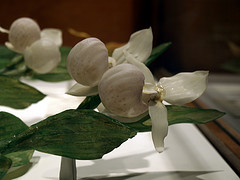
Leopold and Rudolf Blaschkas made these glass models between 1890 through 1936 shipping them from the family studio in Hosterwitz, Germany to Cambridge. Leopold died in 1895, but Rudolf continued on his own stopping only 3 years before his death. Rudolf had no children.
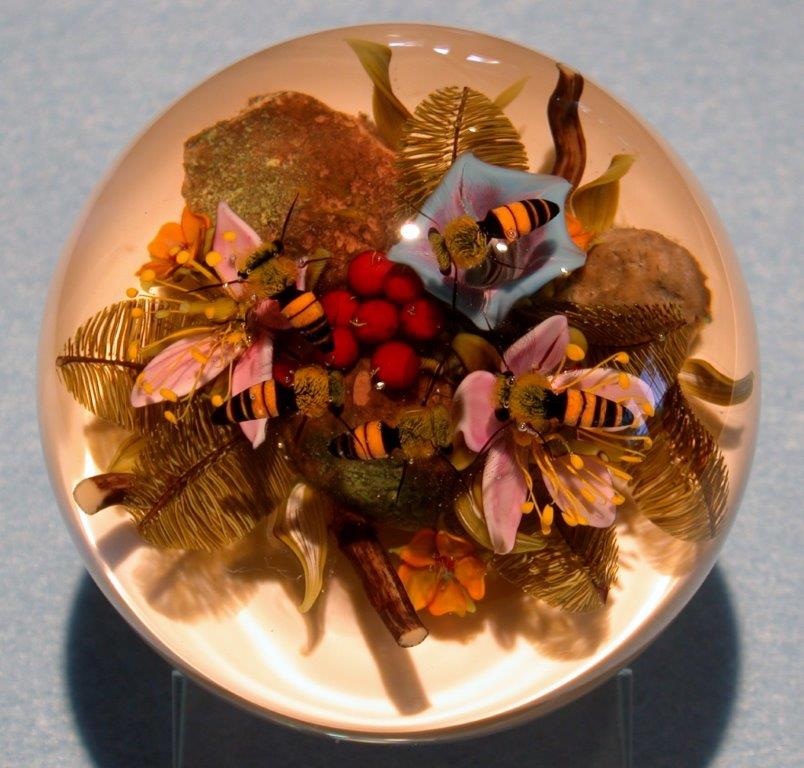
So the secret, it seems is to come from a family passionate about glass or at least, in the case of paperweight makers to pair passion and practice, with persistence and develop a keen awareness of hand and eye in relationship to glass on the end of a pipe.
The glass orchid in image was created by the Blaschkas for the Botanical Museum of Harvard University.