backups of pcatx.org

  • HOME
  • EVENTS
    • February 21st 2026 Meeting Canceled
  • ABOUT
    • Mission
    • Officers
  • HISTORY
    • Past Meetings of PCA TX
      • PCA-TX Meetings 2025
        • Sept 2025 PCATX Meeting
      • PCA-TX Meetings 2024
        • Feb 2024 PCATX Meeting
        • Oct 2024 PCATX Meeting
          • Oct 24 Meeting Hansen Demo Pic’s
      • PCA-TX Meetings 2023
        • May 2023 PCATX Meeting
        • October 2023 PCATX Meeting
      • PCA-TX Meetings 2022
        • February 2022 PCATX Meeting
        • June 2022 PCATX Meeting
        • October 2022 PCATX Meeting
      • PCA-TX Meetings 2021
        • March 2021 Zoom Meeting
        • June 2021 PCATX Meeting
        • November 2021 PCATX Meeting
      • PCA-TX Meetings 2019
        • March 2019 PCATX Meeting
        • July 2019 PCATX Meeting
        • October 2019 PCATX Meeting
      • PCA-TX Meetings 2018
        • March 2018 PCATX Meeting
        • June 2018 PCATX Meeting
        • October 2018 PCATX Meeting
      • PCA-TX Meetings 2017
        • March 2017 PCATX Meeting
        • July 2017 PCATX Meeting
        • Nov 2017 PCATX Meeting
  • GET INVOLVED
    • Member Benefits
      • PCA TX Library Index
    • Join Us
    • Sponsors
  • SCHOLARSHIPS & GRANTS
  • CONTACT US
  • LINKS

A Lovely Detour to Bergstrom-Mahler Museum of Glass

November 22, 2015 By Sue Soy

Almost every year since 2000, Gene and I have traveled from Chicago, where my brother lives, to Minneapolis, to visit my son and family. As paperweight collectors, the road for us does not follow the shortest route, but the more scenic one through Fond du Lac, Oshkosh, and Neenah, Wisconsin. The highlight of this delightful detour is several hours spent at the Bergstrom-Mahler Museum of Glass on the shore of Lake Winnebego in Neenah.

From our very first visit, we have enjoyed seeing this lovely old home dedicated to the history of glass, primarily glass paperweights. In addition to the paperweight galleries, there are special temporary exhibits that are ever changing. When we visited just this past June, the Gordon Parks collection of Rick Ayotte paperweights was on display! Next year, it will be something equally breathtaking. In addition to the fascinating glass displays, the museum and its dedicated staff is always eager to welcome and educate visitors, as well as encourage the work of local students and residents. They have built a glass studio which offers classes in flame working and glass fusing for both youth and adults.

On the right, just as visitors enter, is the irresistible Gift Shop! We have purchased numerous paperweights and other gift items from the shop over the years. Just this year, in response to many requests, the gift shop has opened an online store. Simply go to the Shop tab on the Bergstrom-Mahler Museum of Glass website, www.bmmglass.com, and shop for one-of-a-kind paperweights, art glass, ornaments, and much more. You will not be disappointed!

Of special interest to us this year was the newly-opened Mabel R. McClanahan Study Gallery, a gift to the museum by Gary and Marge McClanahan in honor of Gary’s mother. Mabel was a Wisconsin native who lived in Appleton for many years and was very active in the community throughout her life. After she retired, she partnered with Gary and Marge as paperweight dealers. The gallery is a testament to Mabel’s interest in paperweights and commitment to education.

The Study Gallery houses nearly 600 paperweights in open-storage drawers and display bookcases. It also contains many books about paperweights and glass art and the 20-foot long conference table features 14 lighted compartments that hold paperweights donated by the McClanahans. Blown glass lamps made by local artists provide lighting over the table. This room is full of bright colors and light, and one of the highlights is a very colorful wall mural made of glass and mixed media, designed by Ricky Bernstein. We were excited to learn about how this mural was designed and created; according to Mr. Bernstein, he worked on this mural for six months. It is made mostly of glass and aluminum, and it was amazing to read his account of its creation and compare the artist’s original drawing to the finished mural.

As always, the Museum staff greeted us warmly and was available to explain the various galleries and give us our very own tour. We always love to see this lovely old home-turned-museum, enjoy the view from the back door, and drive around to see the lake just a block away. We always say, if we lived nearby, we would both be thrilled to be Bergstrom-Mahler volunteers!
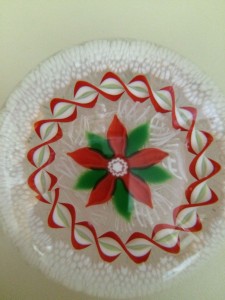
2015 Christmas edition paperweight
The Anniversary Poinsettia Paperweight by John Deacons, Crieff, Scotland
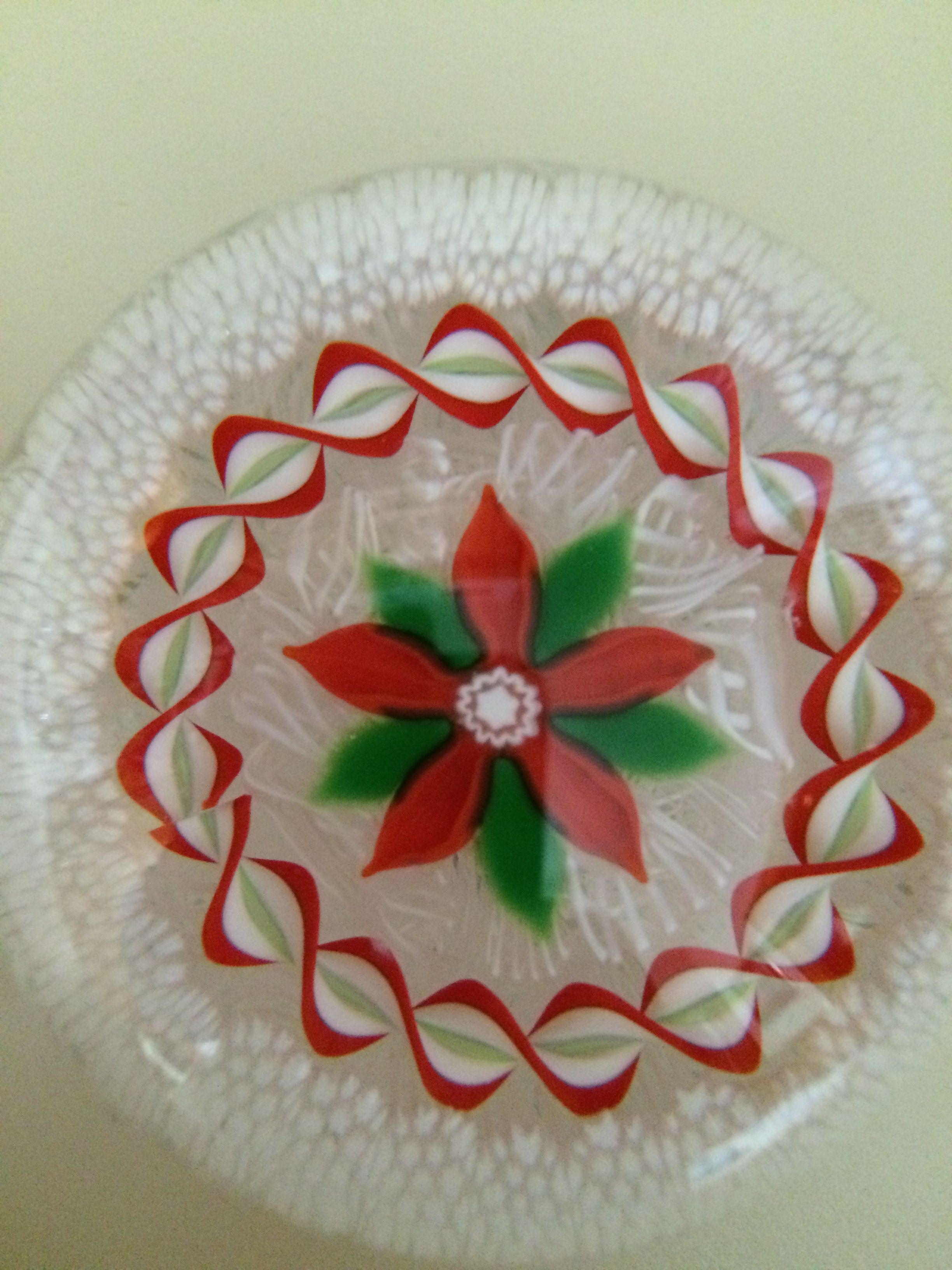
Article contributed by Marie Peiter and was also published in the September 2015 issue of Oklahoma PCA, the newsletter of the Oklahoma Paperweight Collectors Association.
Filed Under: Uncategorized Tagged With: Bergstrom Mahler

A Passion for People and Paperweights

October 21, 2015 By Sue Soy

paperweight
Damon MacNaught Paperweight

William Pitt, like many graduating seniors, figured on a lifetime of work with Ford Motor Company. His degree in Mechanical Engineering from Lawrence Technological University helped him move from the automotive industry to the aerospace industry in California. When aerospace nosedived in the late 1980s, he moved to Massachusetts, thinking of another technical job. Didn’t happen. He needed a different career.

An Alternative to Mechanical Engineering

A friend of his who owned an antique store offered Will a temporary job while he looked for work. Will’s background in corporate settings helped grow his friend’s business. He encouraged his friend to attend shows, improve his advertising and use auctions as an outlet; the business thrived. When his business partner encouraged him to dive into a specialty, he chose paperweights.

“I always liked selling the glass, more than other items. Paperweights became a logical choice as I loved the technology behind the product as much as the beauty of the artistry.” He talked with the artists, read and studied many books about the history and technical aspects of the craft. He was hooked. He started his own business in 1994.

His self-employment created the opportunity to travel worldwide. When he visited Europe, he found his path into the countryside, forming relationships with artists and buyers. In 1996 he developed his website, which shows the artistry of old masters of paperweight, such as Clichy and St. Louis, while introducing the public to emerging artists from the U.S. and other destinations. World renowned artists like Rick Ayotte, Ken Rosenfeld and Debbie Tarsitano are his friends and business associates. They are the artists. He sells their paperweights.

Attracting New Paperweight Collectors

paperweight sale
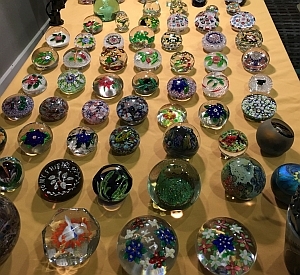
Dealer’s Table of Paperweights for Sale

Will and I talked about the dwindling numbers of paperweight collectors. We can find inexpensive paperweights, even at Walmart, but the antique paperweights can fetch as much or more than $50,000. The manufactured weights (made in quantities) bring far less.

Well known paperweight artists can command anywhere from $200 to thousands of dollars. Some make glass jewelry and other art glass. Paperweight artists break many more pieces than finished products. The “lampwork” entails tiny pieces of glass, which the artist encases in the clear glass, usually using the familiar round shape. Paperweight making requires hours and hours of tedious work. Buying a paperweight is like buying an oil painting from an emerging or famous painter. The weight anyone purchases from a well-known artist will undoubtedly appreciate. A novice paperweight collector needs to study and read glass history and comprehend the value. Beginners benefit from attending paperweight collector meetings and watching for bargains, even when out for a Sunday drive stopping by flea markets or antique stores.

At the Paperweight Collectors Association of Texas’ recent meeting, the group assembled Friday evening for dinner and enjoyed the meeting on Saturday in Fort Worth. Damon MacNaught spoke about his recent training at the Corning Museum of Glass. Mr. Pitt, the featured dealer, brought an outstanding array of paperweights for members to purchase.

My addiction started with curiosity about a weight I inherited. I’ve developed the same passion for paperweights as Will Pitt, but I don’t sell them. If you like glass (especially paperweights), attend the next meeting, in Galveston, Texas on 2/27/2016. See the event tab for additional details.

By Ruth Glover

Filed Under: Uncategorized Tagged With: glass paperweights, MacNaught

Early American Lampworkers

October 11, 2015 By Sue Soy

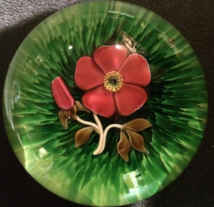
Francis Dyer Whittemore, Jr. Green background with red flower
Francis Dyer Whittemore, Jr. paperweight

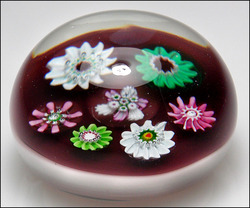
Some of PCA TX member’s favorite paperweight makers are skilled lampworkers who in the 1960s and early 70s began their careers creating scientific glass apparatus using glass rods and hot flames to create industrial products. Charles Kaziun is one of these lampworkers who found his way from scientific lampworking into ornamental glass work and then paperweight making. He was able to experiment with glass and through his fine creative products attracted mentors and advisors throughout his career. He found inspiration in those who came before him including Emil Larson who introduced him to the Millville rose and  Gus (August)  Hofbauer, a man with vast glass knowledge to share and Arthur Gorham, who encouraged and showed paperweights made by Kaziun in his shop.

Kaziun provided inspiration to Francis Dyer Whittemore, Jr., who worked for Dupont and Philco for 16 years in glassmaking and glass research. Frank was invited to become a scientific glassworker instructor at Salem County Vocational Technical Institute, New Jersey. He instructed many young people and it was through sitting in on an ornamental glassmaking class taught by Frank, that Paul Stankard, a student at that school, became fascinated with thoughts of glass paperweight making as a career option. Using his thorough knowledge of glass, his creativity, and experimentation, Frank created beautiful perfect glass miniatures, perfume bottles, jewelry, and prized paperweights. His later weights (1971-1976) are signed with a W cane.

Other lampworkers from this era with familiar names to PCA TX collectors include husband and wife team Hugh and Carolyn Smith, Joe Barker, Harold Hacker, Ron Hansen, Jack Choko, Pete Lewis, William Iorio, Bob Banford, Ray Banford, Lewis Kane, Wes Lutz, and glass cutters Charles Hannah and Walter Earling.

Collectors value these early examples of paperweight making and appreciate these pathfinders who pursued paperweight making using home-made tools in home workshops, their own creativity, and knowledge they acquired from creating scientific glass apparatus.

Maroon background with spaced pasty canes in white pink, green
Charles Kaziun Paperweight

Filed Under: Uncategorized

Meeting October 17, 2015 Fort Worth Cultural District – Meeting Update

September 21, 2015 By Sue Soy

Due to unexpected illness of Marge McClanahan, Marge and Gary McClanahan will be unable to attend the October meeting of PCA Texas. Instead, William Pitt will be our guest dealer and will sponsor Damon MacNaught who has recently completed his course with Debbie Tarsitano and is eager to tell us all about his experience.

Arrangements are being made to meet in the lobby of the Marriott Residence Inn – Cultural District on Friday evening at 5:30 p.m. to carpool to the Friday night group dinner.  On Saturday arrangements are underway to have lunch brought in to the meeting room from Jason’s Deli for members who are interested in that option. Each member will pay for their own box lunch or may go offsite for lunch on Saturday.

Dinner Friday – Mamma Mia Italian Grill & Pizza – 1000 W. Magnolia,  Fort Worth

Dinner Saturday – Cotton Patch Café – 461 IH-20 – Arlington

Excitement is building to see all of the Fall themed paperweights members will be bringing with them to Fort Worth for this meeting!

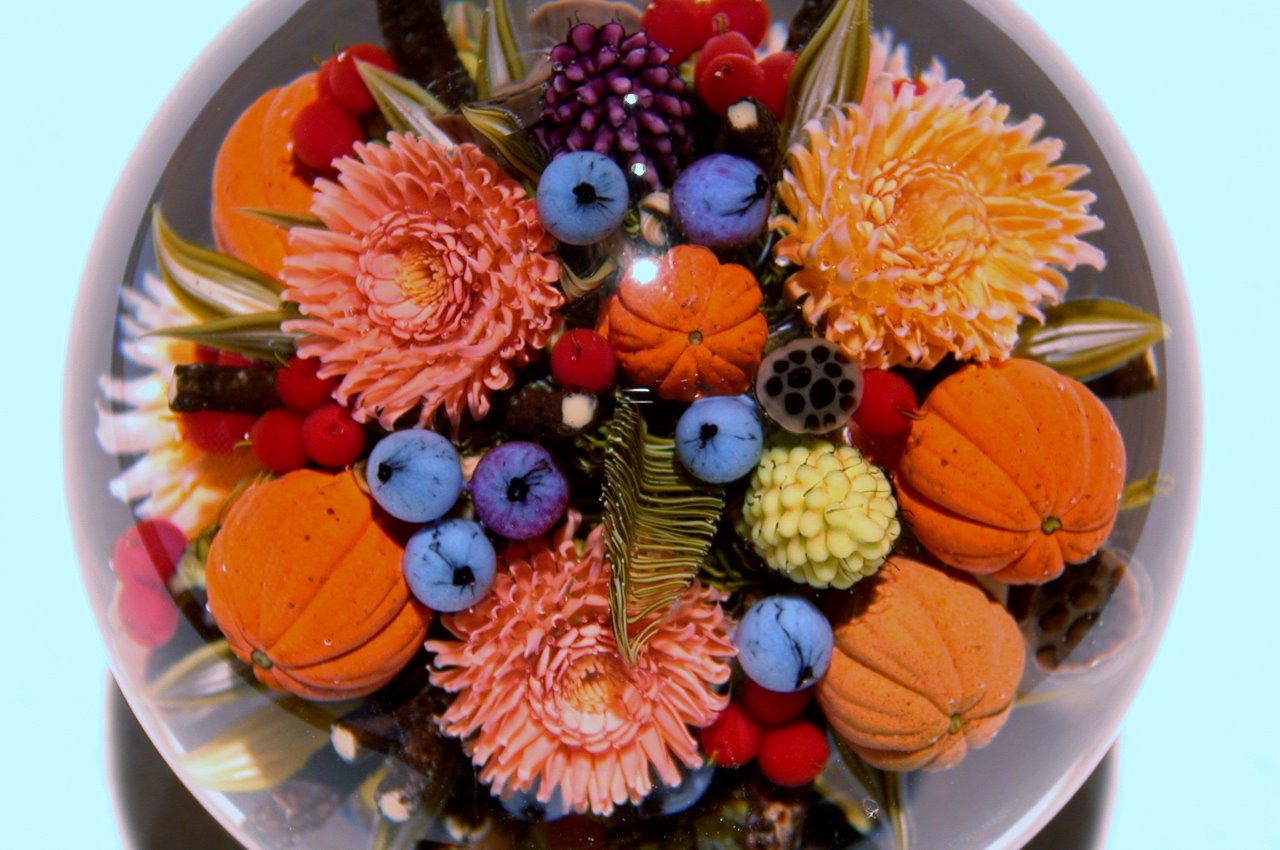
Detailed image of Indian Summer paperweight by David Graeber
Detail of Indian Summer Paperweight Sphere by David Graeber

Filed Under: Uncategorized

The Secret Process

September 12, 2015 By Sue Soy

Can you imagine living with the time-honored tradition (bolstered by an official decree of government) of not being able to leave your job without giving two years notice? Or not being able to travel as far as a mile away from your home and job without receiving official permission? Can you imagine being so valued that you are not allowed to dig in a garden for fear you might hurt your hands? Can you imagine a time when although the same raw materials and tools are available to all, the special craft surrounding crystal and glass manufacture is passed only through family tradition from one person down to the next?

Such is the case among glassworkers in factories in France and elsewhere in the 17th century. Continuity was such that even today, the family names around Moselle Lorraine in France where glassmaking is believed to have been ongoing since the 15th century are still found. Glassmaking was a competitive business filled with experimentation and exploration in the manner of pouring, flattening, and refiring and using carefully concocted combinations of potash, sand, iron oxide, fern-ash, limestone, and manganese to produce clarity in glass; particularly window glass.

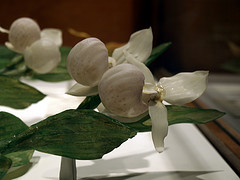
For those who have visited the glass flowers at Harvard University (Cambridge, Massachusetts) in the Ware Collection of Glass Models of Plants, you may recall that the story of sharing glass processes developed over generations repeats with the Blaschka family. Father Leopold and son Rudolf who created on average one glass flower specimen model every 5 days for 50 years experimented and created. Leopold having learned from his father and before him Leopold’s grandfather, passed forward his knowledge to Rudolf. When asked about the secrets in glass making they employed, Leopold wrote to his benefactor Miss Ware: “Many people think that we have some secret apparatus by which we can squeeze glass suddenly into these forms, but it is not so. We have tact. My son Rudolf has more than I have, because he is my son, and tact increases in every generation. The only way to become a glass modeler of skill, I have often said to people, is to get a good great-grandfather who loved glass; then he is to have a son with like tastes; he is your grandfather. He in turn will have a son who must, as your father, be passionately fond of glass. You, as his son, can then try your hand, and it is your own fault if you do not succeed. But, if you do not have such ancestors, it is not your fault.”

Glass Flower Model at Harvard Photo by John Pittman
Photo by John Pittman Flickr Everyone’s Photos Glass

Leopold and Rudolf Blaschkas made these glass models between 1890 through 1936 shipping them from the family studio in Hosterwitz, Germany to Cambridge. Leopold died in 1895, but Rudolf continued on his own stopping only 3 years before his death. Rudolf had no children.

So the secret, it seems is to come from a family passionate about glass or at least, in the case of paperweight makers to pair passion and practice, with persistence and develop a keen awareness of hand and eye in relationship to glass on the end of a pipe.

The glass orchid in image was created by the Blaschkas for the Botanical Museum of Harvard University.

Filed Under: Recent Activities of Interest, Uncategorized Tagged With: Blaschka, paperweights

  • « Previous Page
  • 1
  • 2
  • 3
  • 4
  • Next Page »

Sponsors

Next Event

Everyone is welcome at the meetings of the Paperweight Collectors Association of Texas, Inc. We love to receive guests! We hope to see you there! Unfortunately our February meeting in Livingston has been canceled. For more information please check out our Events Tab

‘The Paperweight’ Newsletter

All members receive a newsletter, The Paperweight, published quarterly. - Click to Learn More!

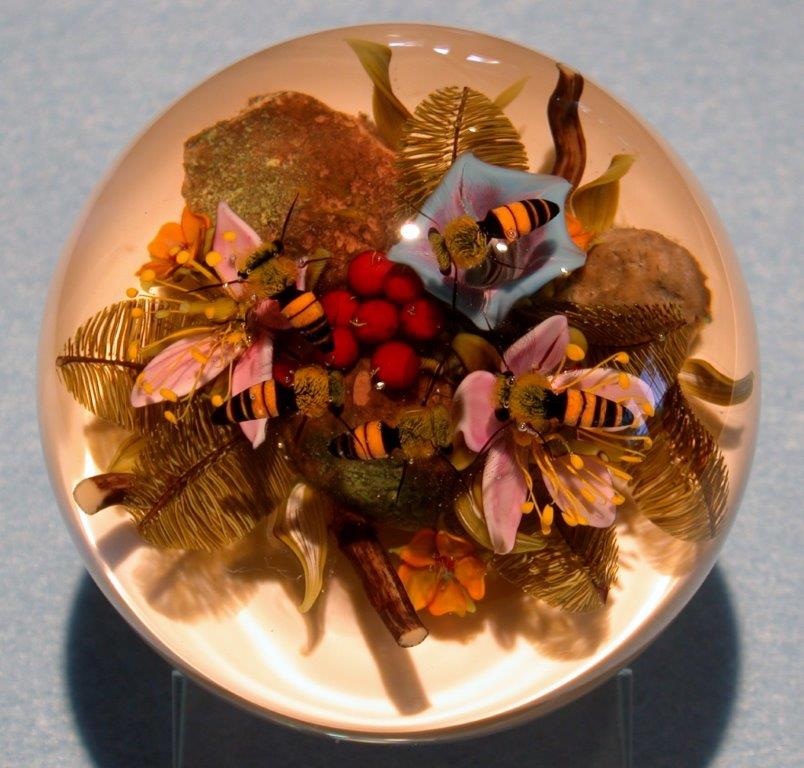
Work by Eric Hansen

Copyright © 2026 · Paperweight Collectors Association of Texas, 42 W. Dansby Drive, Galveston, TX 77551
· President: Ted Glover · Vice-President: Marilyn Turner · Treasurer: Jan Whitley · Secretary: Claire Terry ·